




Bayer Logo Bayer Logo Bayer Logo Bayer Logo

For over a decade, Bayer has been
there for adults living with PAH
(WHO Group 1)*
Lung icon on orange background

*Adempas is approved to treat adults with pulmonary arterial hypertension (PAH) (WHO Group 1). The Adempas clinical studies included mostly patients with WHO functional class II-III symptoms. It is not known if Adempas is safe and effective in children.

WHO=World Health Organization

THERE ARE NOW GENERIC VERSIONS OF ADEMPAS

What are generics?

Generic medications share identical active ingredient, dosage, strength, route of administration,  and intended use as brand name medications.

How to maintain your current treatment routine

If you're concerned about a generic substitution occurring to your current Adempas treatment, talk to your doctor about "Dispense as Written."

What is "Dispense 
as Written"?

"Dispense as Written" is an option your doctor can take in all 50 states that helps to ensure the brand of medicine dispensed at the
pharmacy is what was prescribed.

Check your pills to ensure you're receiving what was prescribed

Are you familiar with what your current brand of medicine looks like? 

Available dosage ranging from 0.5 mg to 2.5 mg

Pharmacies may fill your prescription with a generic without you realizing it. Always check your
pills before taking them. If you believe you've been dispensed a new brand of medicine without
you or your doctor being notified, reach out to customer support at the specialty pharmacy.

aim logo

Bayer remains committed to you

To help you stay on your current treatment routine with Adempas, Bayer offers resources and support like the Aim Patient Support Program to help.

GET SUPPORT

How far might Adempas take you?


Adempas has been shown to help increase the ability to walk farther (measured by a 6-minute walk distance [6MWD] test), improve some PAH symptoms, and help slow down the worsening of a patient’s physical condition. A 6MWD test determines how far patients can walk in 6 minutes. Doctors may use it periodically to measure progress.

Worsening of physical condition includes death, heart/lung transplant, a surgery to reduce pressure in the lung, hospitalization for worsening of pulmonary hypertension (PH), start of a new PAH-specific treatment, continued decline in the ability to exercise (measured by a 6MWD test) and some PAH symptoms.

CHANGE IN 6MWD AT THE END OF 12 WEEKS

A 12-week study of 443 adults with PAH (WHO Group 1) showed that patients who took Adempas walked farther during the 6MWD test, compared to patients who did not take Adempas.
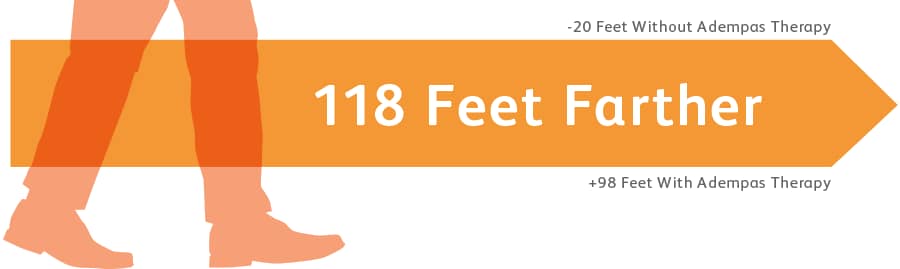
Graphic showing that patients with PAH treated with Adempas walked 118 feet farther in the 6-minute walk distance test compared with patients not treated with Adempas.


50% more patients who took Adempas improved their WHO functional class compared to patients who took a placebo (no Adempas).

21% of Adempas patients showed WHO functional class improvement vs 14% of placebo patients.

Question answer icon
 

Considering Adempas?

Learn more about support for our patients here.

 
   MORE IMPORTANT SAFETY INFORMATION

Adempas may cause serious birth defects if taken during pregnancy.

  • Females should not be pregnant when they start taking Adempas (riociguat) tablets or become pregnant during treatment with Adempas.
  • Females who are able to get pregnant should have a negative pregnancy status before beginning treatment with Adempas.
    • Females who are able to get pregnant are females who have entered puberty, even if they have not started their period, have a uterus, and have not gone through menopause (have not had a period for at least 12 months for natural reasons, or have had their ovaries removed).
    • Females who are not able to get pregnant are females who have not yet entered puberty, or do not have a uterus, or have gone through menopause.

Females who are able to get pregnant should use effective birth control, before starting treatment with Adempas, during Adempas treatment and for one month after stopping Adempas.

  • Talk with your doctor or gynecologist (a doctor who specializes in female reproduction) to find out about options for effective forms of birth control to prevent pregnancy during treatment with Adempas.
  • If you decide that you want to change the form of birth control that you use, talk with your doctor or gynecologist to be sure that you choose another effective form of birth control.

Do not have unprotected sex. Talk to your doctor or pharmacist right away if you have unprotected sex or if you think your birth control has failed. Your doctor may tell you to use emergency birth control.

Tell your doctor right away if you miss a menstrual period or think you may be pregnant for any reason.

If you are the parent or caregiver of a female child who started taking Adempas before reaching puberty, you should check your child regularly to see if she is developing signs of puberty. Tell your doctor right away if you notice that she is developing breast buds or any pubic hair. Your doctor should decide if your child has reached puberty. Your child may reach puberty before having her first menstrual period.

If you are a female who can become pregnant, talk to your doctor to understand the benefits and risks of Adempas.

Do not take Adempas if:

  • you are pregnant, plan to become pregnant, or become pregnant during treatment with Adempas. Adempas can cause serious birth defects.
  • you take:
    • another medicine called a soluble guanylate cyclase stimulator (sGC). Ask your healthcare provider if you are not sure if you are taking an sGC medicine.
    • a nitrate medicine to treat high blood pressure or heart disease, such as nitroglycerin, or a medicine called a nitric oxide donor, such as amyl nitrite
    • certain other medicines that contain sildenafil (Revatio or Viagra), tadalafil (Adcirca or Cialis), vardenafil (Levitra or Staxyn), dipyridamole, or theophylline. Revatio and Adcirca are also used to treat PAH
  • you have pulmonary hypertension associated with idiopathic interstitial pneumonias (PH-IIP).

Ask your doctor or pharmacist if you are not sure if you take any of the medicines listed above.

Before you take Adempas, tell your doctor if you:

  • smoke; have recently had serious bleeding from your lungs, or if you have had a medical procedure called bronchial arterial embolization to stop you from coughing up blood; have problems with your heart or blood circulation; have low blood pressure; have liver problems; have kidney problems or are on dialysis; have narrowing of the pulmonary veins, a condition called pulmonary veno-occlusive disease or PVOD; have any other medical conditions.

Tell your doctor about all the medicines you take, including prescription and non-prescription medicines, vitamins, and herbal supplements. Adempas and other medicines may affect each other causing side effects. Do not start any new medicine until you check with your doctor.

What should I avoid while taking Adempas?

  • Do not get pregnant while taking Adempas. If you miss a menstrual period, or think you might be pregnant, call your doctor right away.
  • It is not known if Adempas passes into your breast milk. You should not breastfeed if you take Adempas. Talk to your doctor about the best way to feed your baby if you take Adempas.
  • Adempas may make you feel dizzy. Do not drive, operate machinery, or do other activities that require mental alertness or coordination until you know how Adempas affects you. Talk with your doctor if you are concerned about when it is safe for you to do these activities.
  • Smoking. Adempas may not work as well if you smoke during treatment. Tell your doctor if you stop smoking or start smoking during treatment with Adempas, because your dose of Adempas may need to be changed.

Adempas can cause serious side effects including:

  • Serious birth defects.
  • Reduced blood pressure. This may cause symptoms of low blood pressure, such as lightheadedness, chest pain, and dizziness especially in people who are dehydrated, have a severe blockage of blood flow out of the heart, or have certain other medical problems. Your doctor will check you for any of these problems.
  • Increased risk of bleeding, including bleeding from the respiratory tract. Tell your doctor right away if you cough up blood during treatment with Adempas.
  • Worsening of symptoms in people with Pulmonary Veno-Occlusive Disease (PVOD). If you have PVOD, treatment with Adempas may cause a build-up of fluid in your lungs (pulmonary edema) which may result in shortness of breath. Your doctor may tell you to stop taking Adempas and switch you to a different medicine.

The most common side effects of Adempas are:

  • Headache; dizziness; indigestion; swelling of your hands, legs, feet, and ankles (peripheral edema); nausea; diarrhea; and vomiting

Tell your doctor if you have any side effect that bothers you or that does not go away. These are not all the possible side effects of Adempas.

Adempas is a prescription medicine used to treat adults with:

  • chronic thromboembolic pulmonary hypertension (CTEPH) (WHO Group 4) treated with surgery but who continue to have high pulmonary blood pressure (persistent) or it comes back after surgery (recurrent), or that cannot be treated with surgery.
    • CTEPH is a type of high blood pressure in the arteries of your lungs caused by blood clots that narrow or block blood flow. Adempas can improve your ability to exercise (measured by 6-minute walk distance) and can help to improve some of your symptoms.
  • pulmonary arterial hypertension (PAH) (WHO Group 1)
    • PAH is a type of high blood pressure in the arteries of your lungs. Adempas can improve your ability to exercise (measured by 6-minute walk distance), improve some of your symptoms, and help slow down the worsening of your physical condition [this includes death, heart/lung transplant, a surgery to reduce pressure in your lung, hospitalization for worsening of pulmonary hypertension, start of a new PAH-specific treatment, continued decline in your ability to exercise (measured by 6-minute walk distance) and some of your symptoms].

The Adempas clinical studies included mostly patients with WHO functional class II-III symptoms. It is unknown if Adempas is safe and effective in children.

For important risk and use information please see the full Prescribing Information, including Boxed Warning and Medication Guide.